Acne scars are not all the same, which means treating them should not be one-size-fits-all. RF microneedling can help remodel collagen and improve certain indented scars, while treatments such as subcision or TCA CROSS may be better for others. Understanding the type of scar is the first step toward choosing the right treatment.
Microneedling for Acne Scars: How It Works & Who It’s For
Acne may eventually clear, but the changes it leaves behind can sometimes be more difficult to treat. Indented scars, uneven texture, and areas where the skin no longer looks as smooth can remain long after the active breakout is gone.
This is where RF microneedling can help.
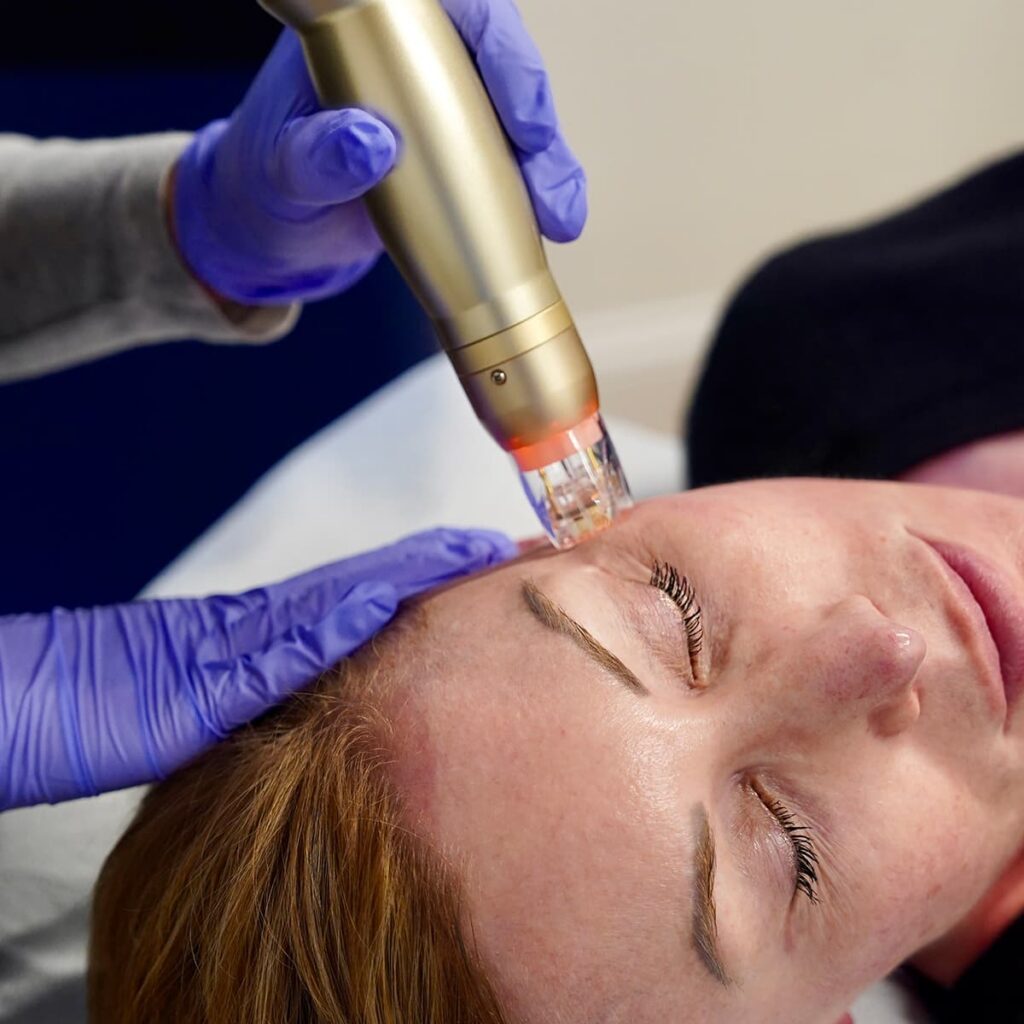
RF microneedling combines traditional microneedling with radiofrequency energy to stimulate collagen remodeling beneath the skin. For the right type of acne scar, this process can gradually improve texture and make scars appear softer and less noticeable.
But not every acne scar responds the same way. Understanding what type of scar you have is one of the most important parts of choosing the right treatment.
What Is RF Microneedling?
RF microneedling, or radiofrequency microneedling, combines two technologies in one treatment.
Very small needles create controlled micro injuries in the skin while radiofrequency energy is delivered at specific depths beneath the surface. This controlled injury triggers the skin’s natural healing response and encourages new collagen and elastin production.
Traditional microneedling also stimulates collagen through controlled micro injuries. RF microneedling adds thermal energy below the skin, creating another source of controlled collagen remodeling.
At 817 Surgical Arts, we use Sylfirm X, an RF microneedling device that allows treatment depth and energy to be customized based on the patient’s skin and treatment goals.
How Does Microneedling Help Acne Scars?
When acne causes significant inflammation, the skin may not replace collagen evenly as it heals.
If too little collagen is produced, an indentation can remain in the skin. These are known as atrophic acne scars.
RF microneedling creates controlled injury within the dermis to encourage new collagen and elastin production. As remodeling takes place, the skin around the scar can gradually become firmer and smooth.
This process does not happen overnight.
Collagen remodeling continues for weeks and months after treatment, which is why results tend to develop gradually rather than immediately.
Which Acne Scars Respond Best to Microneedling?
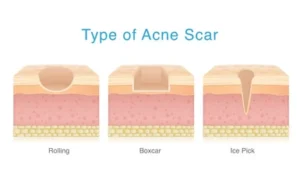
There are three common types of depressed acne scars: rolling, boxcar, and ice pick scars.
Although they can appear on the same face, they do not necessarily need the same treatment.
Rolling Scars
Rolling scars are broad, shallow depressions that create a wavy or uneven appearance across the skin.
RF microneedling can be helpful for improving the overall texture associated with rolling scars. However, some rolling scars are also tethered to deeper tissue.
If the scar is being pulled downward, stimulating collagen from above may not fully correct the problem. This is where a treatment such as subcision may be needed.
Boxcar Scars
Boxcar scars are round or oval depressions with more defined edges.
Shallow and moderate boxcar scars can respond well to collagen stimulating treatments such as RF microneedling. Deeper boxcar scars may need a combination approach depending on their depth and structure.
Ice Pick Scars
Ice pick scars are narrow but extend deeper into the skin.
Because of their depth, they tend to be more difficult to improve with RF microneedling alone. A targeted treatment such as TCA CROSS may make more sense for certain ice pick scars.
This is a good example of why identifying the scar matters before choosing the treatment.
What Is Subcision?
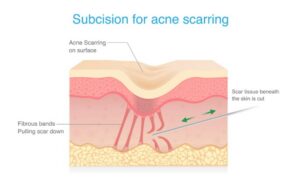
Subcision is a procedure used to treat acne scars that are tethered beneath the skin.
Some depressed scars are held down by fibrous bands underneath. Think of these bands almost like tiny anchors pulling the surface of the skin downward.
During subcision, a medical provider carefully releases those fibrous attachments beneath the scar. Once the scar is no longer being pulled down, the skin has an opportunity to lift and remodel.
Subcision is particularly useful for certain rolling scars.
Subcision + RF Microneedling
This is where a combination treatment can become helpful.
Subcision and RF microneedling address two different parts of the scar. Subcision releases the tethering underneath, while RF microneedling encourages collagen remodeling throughout the treated area.
If a scar is firmly anchored down, repeatedly stimulating collagen without releasing the attachment may only take the improvement so far.
Research has found greater improvement when RF microneedling is combined with subcision in appropriately selected acne scars compared with RF microneedling alone.
That does not mean everyone needs subcision.
This is why an acne scar consultation should involve more than simply looking at the surface of the skin.
Why We Use Sylfirm X RF Microneedling
At 817 Surgical Arts, our RF microneedling device is Sylfirm X.
Sylfirm X delivers radiofrequency energy through microneedles at controlled depths within the skin. This allows us to adjust the treatment based on the area being treated, the patient’s skin, and what we are trying to improve.
One advantage of RF microneedling is that it can be used across all Fitzpatrick skin types. Because RF energy works beneath the surface rather than relying on a laser that targets pigment, RF microneedling can be an option for a wider range of skin tones.
That does not mean every patient’s treatment should be identical. Settings, depth, treatment plan, and aftercare should still be customized for the individual.
RF Microneedling vs. Traditional Microneedling
Both treatments create controlled micro injuries that stimulate the skin’s natural healing response.
The difference is the addition of radiofrequency.
Traditional microneedling relies on the mechanical injury created by the needles to stimulate collagen. RF microneedling delivers controlled thermal energy beneath the skin at the same time.
For acne scarring, that additional energy allows us to target deeper collagen remodeling while still treating the skin through very small entry points.
Neither treatment makes a scar disappear completely. The goal is to make scars shallower, softer, and less noticeable over time.
How Many Microneedling Treatments Do You Need?
Acne scars require a series rather than a single treatment.
The number of sessions depends on the type and severity of scarring, how your skin responds, and whether RF microneedling is being used alone or with another treatment.
For many patients, a series of approximately three treatments may be recommended as a starting point.
The important part is allowing enough time for collagen remodeling between treatments and after the series is complete. Your skin continues changing after the treatment itself is over.
This is why before and after photos taken too soon may not show the final result.
Who Is NOT a Good Candidate for RF Microneedling?
RF microneedling can be used safely across a wide range of skin tones, but that does not mean it’s appropriate for everyone at every time.
We wouldn’t want to perform microneedling directly over significant active, inflamed acne, particularly deep, painful, or pus-filled lesions. The active breakouts will need to be controlled first.
Treatment may also need to be postponed or avoided if you have an active skin infection, sunburn, open wounds, significant irritation, and a compromised skin barrier.
Certain medical conditions, medications, a history of poor wound healing or keloid scarring, and other individual factors may also affect whether you are a candidate.
This is why a consultation and complete health history matter.
Active Acne Comes Before Acne Scars
If you are still experiencing frequent active breakouts, the first priority is to get your acne under control.
New inflammation can create new scars.
It doesn’t make much sense to aggressively treat old acne scars while uncontrolled acne continues creating new ones. Getting the breakouts under control first allows us to focus on what the acne has left behind.
Your plan may begin with the right home skincare routine, professional acne treatments, prescription treatment when appropriate, or a combination of approaches.
Once your acne is stable, scar treatments can be performed.
Microneedling vs. TCA CROSS for Acne Scars
Neither treatment is automatically better. They simply address different scar characteristics.
RF microneedling treats a broader area and stimulates collagen remodeling throughout the skin. It can be particularly useful for rolling scars, boxcar scars, and overall uneven texture.
TCA CROSS is a targeted treatment. A high concentration of trichloroacetic acid is carefully placed into depressed scars to create controlled remodeling within the scar itself. This can be especially useful for deep ice pick scars.
Someone with mixed acne scarring may benefit from both treatments at different points in their treatment plan.
What About Chemical Peels?
Chemical peels can also play a role, but again, we are treating a different part of the problem.
Peels can be helpful for congestion, post-inflammatory hyperpigmentation, uneven tone, and more superficial texture concerns.
RF microneedling focuses more heavily on collagen remodeling beneath the skin, making it better suited for certain structural acne scars.
If your biggest concern is a flat brown mark left behind after a breakout, a pigment balancing chemical peel could be a better treatment option.
Knowing whether you are dealing with pigmentation or an actual scar can save you a lot of time and unnecessary treatments.
Sometimes the Best Acne Scar Treatment Is More Than One Treatment
This is probably the most important thing to understand about acne scar treatment.
You may have rolling scars on one part of your cheek, a few boxcar scars somewhere else, and two deep ice pick scars in another area.
One treatment doesn’t necessarily need to do everything.
A customized plan may include RF microneedling for overall collagen remodeling, subcision for tethered rolling scars, TCA CROSS for deeper ice pick scars, and chemical peels or skincare for discoloration.
The goal is not to perform as many treatments as possible. It’s to identify what’s creating the texture you see and to choose the treatment that makes sense for each concern.
Start With Understanding Your Acne
Acne scar treatment makes much more sense once you understand how the scars developed in the first place.
Our Complete Guide to Acne breaks down the different types of breakouts, what may cause them, ingredients that can help, and when professional treatment may be appropriate.
If active acne is still your biggest concern, start there.
If your breakouts are controlled but the scars are what bother you now, we can take a closer look at the type and depth of your scarring and determine whether RF microneedling, subcision, TCA CROSS, or a combination approach may make the most sense.
At 817 Surgical Arts, we use Sylfirm X RF microneedling to create customized treatment plans based on your skin and concerns.
Ready to figure out what your scars actually need? Schedule an appointment with 817 Surgical Arts so we can assess your skin and create a plan based on the scars you have, not just the word “acne scars.” To call or text: 817-290-9900